.avif)
A welcoming practice for nervous patients
Our whole team has trained extensively in caring for nervous patients, and supporting people with dental anxiety has been a central part of our practice since the very beginning.
Over the years, we have helped many patients who previously avoided the dentist due to fear or past experiences. With gentle care, clear communication, and a calm approach, we’ve helped them regain confidence in dental visits while improving their oral health.
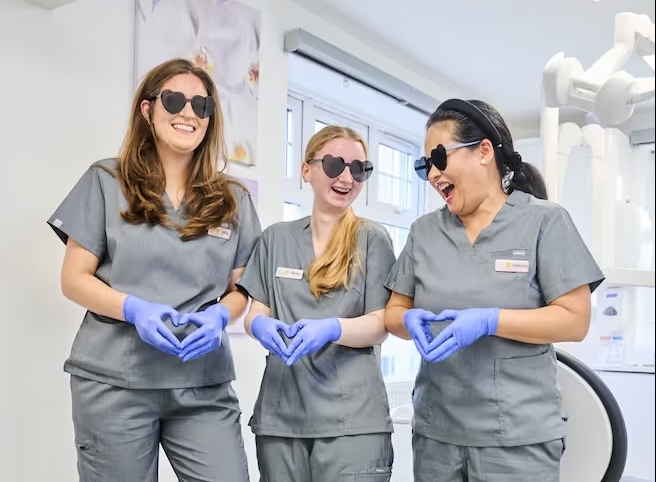
Many of our patients choose Floss and Smile specifically because we are known locally for helping nervous patients feel comfortable and in control during their treatment.
We are proud to be rated 4.9 on Google with over 225 reviews, and many of those reviews come from patients who once felt anxious about visiting the dentist.

Gentle care for nervous patients
Very few people feel completely relaxed about visiting the dentist. Some people feel slightly anxious, while others may feel frightened or have avoided dental treatment for many years.
Dental anxiety can lead to a cycle where routine check-ups are avoided, allowing small issues to develop into more serious problems.
Our goal is to break that cycle.
All of our dentists are experienced in caring for nervous patients and take time to understand what may be causing your anxiety. We use gentle behavioural techniques and clear communication to help you feel informed, supported, and in control throughout your visit.
We move at your pace and make sure every step of your treatment feels comfortable.
.jpeg)
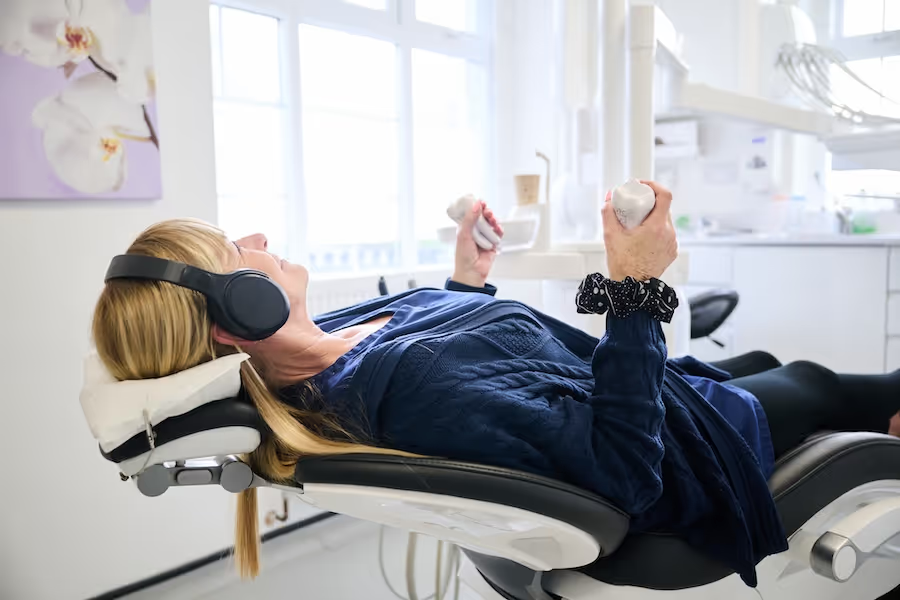
Relaxation before and during your appointment
Creating a calm and supportive environment is an important part of helping nervous patients feel more comfortable. Before and during your visit, we focus on making your experience feel unhurried and reassuring.
You remain in control throughout your treatment, and we will always respond immediately if you need to stop or take a moment to relax.
- A friendly team who genuinely care about how you feel
- Appointments that never feel rushed
- Time taken to ensure anaesthetic is fully effective before treatment begins
- Clear explanations so you know what to expect
- The ability to pause or take a break whenever you need
Your Comfort Comes First
We have designed our practice to be a calm and relaxing environment where your comfort and wellbeing are always a priority. If there is anything that helps you feel more relaxed, simply let our team know and we will do our best to accommodate it.
To help you feel more at ease, we offer:
- TVs on the ceiling with headphones - Watch your favourite programmes during your appointment to help distract and relax you.
- Music of your choice via Spotify - Choose calming music, podcasts, or anything else you enjoy listening to.
- Lavender essential oils - Lavender aromatherapy can help create a relaxing environment and reduce feelings of anxiety.
- Oral sedation for additional support - For patients who feel they may need extra help relaxing, we can offer carefully prescribed oral sedation.
.avif)
Building trust and confidence
For many nervous patients, building trust with their dental team is the most important step.
We take time to understand the root cause of your anxiety and work gradually with you to rebuild confidence in dental care. Many patients find that once they experience our calm and supportive approach, their anxiety reduces significantly over time.
Our approach includes:
- Taking time to listen and understand your concerns
- Allowing you to get to know our team before treatment begins
- Delivering treatment gently and at a comfortable pace
- Ensuring every procedure is carried out pain-free and without pressure
.avif)
Oral sedation for nervous patients
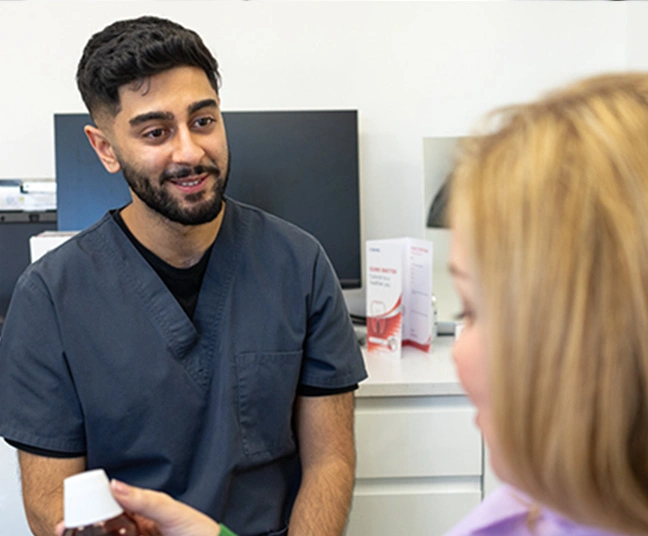
For patients who feel they may need additional support, we also offer oral sedation.
Oral sedation involves taking a carefully prescribed anti-anxiety tablet before your appointment. This helps you feel more relaxed and drowsy while still remaining awake and able to respond during treatment.
Sedation is designed to reduce anxiety, but it does not replace pain control. Local anaesthetic is still used to ensure treatment is completely comfortable.
Importantly, many nervous patients find that once they experience our gentle approach, they often do not require sedation for future visits.
It can be helpful for patients who:
- Feel very anxious about dental treatment
- Have had difficult dental experiences in the past
- Struggle with a strong gag reflex
- Feel overwhelmed by dental environments
- Need longer appointments or more complex treatment
.avif)
.avif)
What treatments can sedation help with?
Oral sedation may be considered for a variety of treatments where anxiety could otherwise make care difficult, including:
- Dental examinations and X-rays for very anxious patients
- Fillings and restorative treatment
- Hygiene visits where sensitivity or anxiety is high
- Root canal treatment
- Tooth extractions
- Dental implants or longer appointments where appropriate
Sedation suitability depends on your medical history and the treatment required, and we always carry out a careful assessment beforehand.
Your journey as a nervous patient
.avif)
.avif)
.avif)
.avif)

.avif)
Nervous patient care and sedation
Will I be asleep with oral sedation?
No. Oral sedation is conscious sedation, meaning you will feel relaxed and drowsy but remain awake and able to respond.
Is oral sedation safe?
For suitable patients, oral sedation is widely used. We carefully review your medical history and only recommend it when appropriate.
Can I drive home after sedation?
No. You will need someone to accompany you and you should not drive after oral sedation.
Can anyone have sedation?
Sedation may not be suitable for some medical conditions, certain medications, pregnancy, or if you do not have an escort to take you home. If sedation is not appropriate, we will discuss alternative ways to help you feel comfortable.
What should I do before my sedation appointment?
We will give you clear instructions before your visit. You will also be asked about your medical history and any medications you take.
Will I be asleep with oral sedation?
No. Oral sedation is conscious sedation, meaning you will feel relaxed and drowsy but remain awake and able to respond.
Is oral sedation safe?
For suitable patients, oral sedation is widely used. We carefully review your medical history and only recommend it when appropriate.
Can I drive home after sedation?
No. You will need someone to accompany you and you should not drive after oral sedation.
Can anyone have sedation?
Sedation may not be suitable for some medical conditions, certain medications, pregnancy, or if you do not have an escort to take you home. If sedation is not appropriate, we will discuss alternative ways to help you feel comfortable.
What should I do before my sedation appointment?
We will give you clear instructions before your visit. You will also be asked about your medical history and any medications you take.
I’m interested in getting dental implants, what should I do?
The first thing to do is to book a consultation with us here at Floss and Smile! At your consultation we will answer any questions you may have. Based on a comprehensive examination we will plan the best treatment for you and walk you through all the costs involved. Our patients get extra reassurance by having access to a text mobile 24/7 during and after the treatment.
I have a loose denture. Can dental implants help me?
Yes they can. Dental implants are an excellent solution for the millions of people who have loose dentures and offer many advantages over conventional dentures. Conventional dentures are often uncomfortable and, due to the movement, limit a person’s ability to speak and eat normally. Because of this, many people feel self-conscious wearing their dentures. The dentures can be secured into place by locking on to 2-4 implants. Implants are commonly used to replace individual missing teeth, but they can also be used to secure or stabilise loose dentures in either the upper or lower jaws. Instead of having a crown (cap) fitted to the top of the implant a precision-made attachment is fitted which inserts into the underneath surface of the denture, securing the denture to the implant. In the lower jaw this can be achieved with as few as two implants. If there is sufficient bone available and you are willing to have more implants inserted then you can often be fitted with a completely solid set of teeth attached to the dental implants (a full-arch bridge). This set of teeth would stay in permanently and would look and feel very similar to a natural set of teeth.
Is dental implant placement painful?
Dental implants are typically placed under local anaesthetic to ensure you are comfortable throughout the treatment. If you are very nervous or suffer from dental phobia we can offer you sedation. Our whole team has trained extensively in caring for nervous patients, and over the years, we've successfully treated many people with high levels of anxiety. We've not only transformed their smiles and improved their oral health but also significantly reduced their dental treatment-related anxiety.
How long does it take to place dental implants?
Your dental implants may be placed in as little as 30 to 60 minutes, depending on the location and the number of implants being placed. Your dentist will be able to give you a clear idea of the treatment time during your first appointment with us.
When will I receive my new teeth?
Treatment time varies for each patient. Typically, you will have some type of temporary teeth until your implants bond to the bone. We can provide a time estimate based on your treatment needs, during your initial consultation here in Dunstable.
How do I care for my dental implants?
Home care for your implants consists of brushing and flossing. Regular dental visits are required for long term health and success.
How long can dental implants last?
Implants can last many years if cared for properly. Many implants have been in place for more than 40 years.
How does the long term value of dental implants compare to other options?
Dental implants are low maintenance and provide stability and confidence in your smile. Therefore, the long term value of dental implants far exceeds conventional treatment options.
Are dental implants safe?
Yes, dental implants are considered a safe and effective treatment option for replacing missing teeth. At Floss and Smile, our dentists have a special interest in dental implant surgery and have restored hundreds of smiles over the years, using gold standard implants.
How long does it take to get dental implants?
The journey to receiving dental implants varies based on personal factors like oral health, potential need for procedures such as bone grafting, and the body's healing response. Typically, from the first consultation to achieving a complete restoration, the process spans several months. This period allows for the implant to fuse securely with the jawbone (known as osseointegration), a critical phase lasting approximately 3 to 6 months.
Is dental implant treatment painful?
Dental implant treatment is carried out under local anaesthetic, so you won’t feel pain during the procedure. Most patients are surprised at how comfortable it is, and any mild discomfort afterwards can usually be managed easily. We also offer sedation options if you feel anxious.
Can I get dental implants if I don’t have enough bone?
Even if you’ve been told you don’t have enough bone, you may still be suitable for dental implants following a full assessment. We use advanced 3D scans to evaluate your bone, and in many cases additional treatments such as bone grafting or specialist implant techniques can help make implants possible.
What happens if a dental implant doesn’t heal as expected?
Dental implants have a very high success rate when carefully planned and maintained. In the unlikely event that an implant doesn’t heal as expected, we will support you every step of the way and guide you through the most appropriate next steps. Your peace of mind is important to us, which is why implants are covered by our one-year guarantee.
Are your dental implants guaranteed?
Yes - for your peace of mind, all dental implants at Floss & Smile are covered by our one-year guarantee.
If your dental implant needs to be replaced within the first 12 months, there will be no charge for the implant itself, provided certain conditions are met.
The guarantee may not apply in the following situations:
- Additional treatment (such as bone grafting) was recommended before implant placement but was not carried out
- A different treatment option was advised as more suitable but not followed
- The restoration provided was intended to be temporary
- A like-for-like replacement is not clinically appropriate
- Further treatment has been carried out on the tooth or implant since the original procedure
Why do you use UK-based dental laboratories?
We choose to work with trusted UK-based dental laboratories to ensure the highest standards of quality, safety and reliability throughout your treatment. These laboratories are highly regulated and GDC-compliant, providing exceptional craftsmanship, full traceability of materials, and restorations that are durable, natural-looking and tailored to you.
Working with local laboratories also allows for faster turnaround times and close collaboration between our clinical team and technicians, resulting in more precise, accurate outcomes. In addition, UK labs follow strict infection control and safety regulations, giving you complete peace of mind at every stage of your treatment.
The next step
If dental anxiety has prevented you from visiting the dentist, our team is here to help.
We will take the time to understand your concerns and support you with gentle, unhurried care designed around your comfort.

%402x.avif)
